
Why Am I Bloated Every Day? 7 Common Reasons (And What Nobody’s Telling You)
You wake up feeling relatively fine.
Then, as the day goes on, your stomach starts to feel fuller, tighter, more swollen.
Maybe it happens after lunch. Maybe it gets worse by evening. Or maybe it happens so often you’ve started wondering if this is just normal for you now.
Occasional bloating is common. But when it seems to happen every single day, it’s natural to start looking for an explanation.
And here’s the thing: you’ve probably already tried the obvious one.
You’ve Already Cut the Usual Suspects — And You’re Still Bloated
Gluten. Dairy. Soda. Beans.
If you’ve been dealing with daily bloating, there’s a good chance you’ve already eliminated at least one of these at some point — only for the bloating to come back anyway.
That doesn’t necessarily mean one particular food is the problem.
Bloating can involve several overlapping factors: how you eat, how much you eat, recent changes to your fiber intake, constipation, and how certain carbohydrates are fermented in your gut.
Understanding those patterns is a much better starting point than eliminating foods at random — again.
Quick Answer
If you feel bloated every day, there may not be one single cause.
Bloating can be tied to excess intestinal gas, eating habits, constipation, certain foods or carbohydrates, and sudden changes in fiber intake.
One of the most useful things you can do is pay attention to when the bloating starts and what tends to happen right before it.
That pattern can tell you a lot more than labeling individual foods “good” or “bad.”
1. You May Be Swallowing More Air Than You Realize
Not all digestive gas comes from food being broken down in your intestines.
Some of it starts with something much simpler: swallowed air.
Eating quickly, drinking carbonated beverages, chewing gum, and other habits can increase the amount of air you swallow — and some of that air can contribute to belching or gas.
If your bloating tends to show up around meals, start by noticing how you eat, not just what you eat.
Are you rushing through lunch? Eating at your desk while working? Drinking several carbonated drinks throughout the day?
Small habits are easy to overlook when you’re focused only on ingredients.
2. Your Meals May Be Bigger Than Your Digestive System Is Used To
Sometimes the explanation is simple.
A large meal puts more food into your digestive system all at once.
That feeling of fullness after eating doesn’t automatically mean something’s wrong.
But if you keep noticing discomfort after particularly large meals, portion size may be part of the pattern worth paying attention to.
Compare how you feel after a very large meal versus a smaller one.
The goal isn’t necessarily to eat less overall — it’s to understand whether meal size changes how you feel.

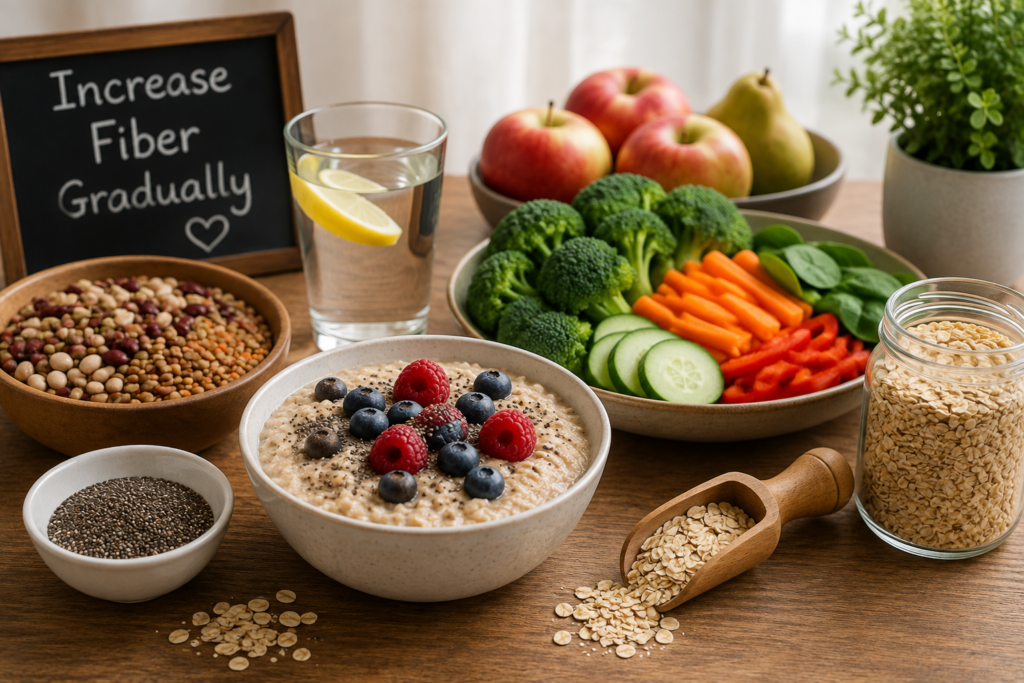
3. You May Have Increased Your Fiber Too Quickly
Here’s a contradiction that catches a lot of people off guard:
Trying to improve your diet by dramatically increasing fiber can temporarily make you feel more bloated.
Imagine switching breakfast to oatmeal and berries, adding beans at lunch, eating more vegetables at dinner, and starting to snack on nuts and seeds — all within a few days.
Those are nutritious choices.
But your digestive system just went through a major shift too.
Some fiber reaches your colon, where gut bacteria can ferment it. Ramping up your intake quickly can mean more gas and bloating while your system adjusts.
That’s why gradually increasing fiber tends to be more comfortable than trying to eat as much of it as possible all at once.
And there’s another detail that matters here:
Fiber isn’t just one thing.
Different types of fiber behave differently during digestion — and this is where generic “just eat more fiber” advice can become less useful.
More Fiber Isn’t Always the Whole Answer
When you’re bloated on a regular basis, it’s tempting to look for one food to eliminate or one ingredient that fixes everything.
Digestion is rarely that simple.
How much fiber you eat can matter, but so can the type, source, and speed at which you increase it.
Soluble fiber, for example, interacts with water during digestion and can form a gel-like material.
One soluble dietary fiber you may come across in digestive-support products is glucomannan, which comes from the konjac plant.
And this is where looking at the actual ingredient list becomes more useful than relying only on the promises on the front of a bottle.
DigestSync lists konjac glucomannan among its ingredients, along with baobab, pea starch, and biogenic polyamines.
That doesn’t mean the formula will eliminate bloating, and research on an individual ingredient doesn’t automatically prove the effects of a finished supplement.
But if you’re already exploring digestive-support products, knowing what’s actually in the formula gives you a better starting point for deciding whether you want to learn more.
Why DigestSync Is Relevant to This Conversation
DigestSync contains konjac glucomannan, along with baobab, pea starch and biogenic polyamines. If you’re exploring digestive support beyond food alone, taking a closer look at the formula can help you understand what the product actually contains before deciding whether it’s something you want to explore further.
4. Not Drinking Enough Fluids Can Matter When You Increase Fiber
Fiber and fluids belong in the same conversation.
Some types of fiber interact with and absorb water as they move through your digestive system.
That’s one reason simply piling on more and more high-fiber foods without thinking about hydration may not be the best approach.
If you’re deliberately increasing your fiber intake, pay attention to your fluid intake too.
Think of the change as a combination:
gradual fiber + adequate fluids + attention to how your body responds.
Not a race to hit the highest fiber number possible.
5. Constipation Can Be Making You Feel Bloated
Bloating and constipation can show up together.
When stool moves slowly through your digestive tract, you may experience fullness, pressure, or bloating.
That’s another reason it can be misleading to focus only on the last thing you ate.
Ask yourself a broader question:
Has anything else about my digestion changed?
If bloating tends to show up alongside difficulty having bowel movements or changes in your usual bathroom habits, that pattern is worth paying attention to.
And if constipation is persistent or concerning, talk to a healthcare professional instead of continuing to experiment with your diet on your own.
6. Some Nutritious Foods Can Still Make You Gassy
This is one of the most important things to understand.
Foods associated with gas aren’t necessarily bad foods.
Beans are a good example.
They provide fiber and other nutrients, but they can also contribute to gas for some people because of how certain carbohydrates are broken down by gut bacteria.
The same idea can apply to other nutritious foods.
So if you feel bloated after eating something healthy, that doesn’t automatically mean you should cut it out for good.
Instead, look at:
- how much you ate;
- whether it was new to your diet;
- whether you recently increased fiber overall;
- how fast you ate;
- and whether the same pattern keeps happening.
Your pattern matters more than any single meal.
7. Certain Carbohydrates May Be Producing More Gas in Your Gut
Sometimes it isn’t simply the amount of food you’re eating.
Certain carbohydrates aren’t fully digested before they reach the large intestine.
Once there, gut bacteria can break them down — a normal process that can produce gas.
That helps explain why some people notice more bloating after certain foods even when those foods are nutritious.
And again, individual responses vary.
The goal isn’t to create a long list of foods you’re afraid to eat.
It’s to notice whether the same foods, portions, or combinations repeatedly seem to line up with your symptoms.
So What Should You Actually Do If You’re Bloated Every Day?
Start by observing before you start eliminating.
For a few days, pay attention to when your bloating shows up.
Is it mostly after meals?
Does it happen after particularly large ones?
Did it get more noticeable after you increased fiber?
Are you also constipated?
Do certain foods consistently seem to produce more gas for you?
You don’t need to obsess over tracking every bite.
The point is simply to spot patterns.
Once you know what tends to happen before the bloating starts, it becomes easier to decide what actually deserves your attention — and what doesn’t need to disappear from your diet for no reason.
What About Digestive-Support Supplements?
This is where it pays to be careful.
A supplement shouldn’t replace a balanced diet, adequate fluids, or appropriate medical care.
And a digestive-support product shouldn’t be treated as a guaranteed fix for everyday bloating.
But if you’re already exploring this category, look at the formula, not just the claims on the front of the bottle.
With DigestSync, one ingredient that connects directly with our fiber discussion is konjac glucomannan.
The formula also lists baobab, pea starch, and biogenic polyamines.
Understanding what a product contains can help you evaluate it more carefully instead of assuming every digestive-support supplement is the same.
Want to Take a Closer Look at the Formula?
If you’re curious about DigestSync after reading about fiber and everyday bloating, you can take a closer look at the complete formula and learn more before deciding whether it’s something you want to consider.
When Should You Talk to a Healthcare Professional?
Bloating can be common, but persistent or severe symptoms deserve more attention.
Talk to a qualified healthcare professional if your bloating is persistent, gets worse, significantly interferes with your daily life, or appears alongside other concerning symptoms.
Dietary changes and supplements shouldn’t be used to delay appropriate medical evaluation.
The Bottom Line
If you feel bloated every day, don’t automatically assume there’s one “bad” food to blame.
Your eating habits, meal size, intestinal gas, constipation, certain carbohydrates, and changes in fiber intake can all contribute to how your stomach feels throughout the day.
And when it comes to fiber, more isn’t automatically better.
How much you eat, how quickly you increase it, and the type of fiber you’re getting can all be worth paying attention to.
Start with your patterns.
Make changes gradually.
Pay attention to fluids.
And if you decide to explore digestive-support products, look past the marketing and understand what’s actually inside the formula before making your decision.
Sources
National Institute of Diabetes and Digestive and Kidney Diseases (NIDDK) — Gas in the Digestive Tract
National Institute of Diabetes and Digestive and Kidney Diseases (NIDDK) — Eating, Diet & Nutrition for Gas in the Digestive Tract
Mayo Clinic — Dietary Fiber: Essential for a Healthy Diet
Mayo Clinic — Gas and Gas Pains
1 Comentário